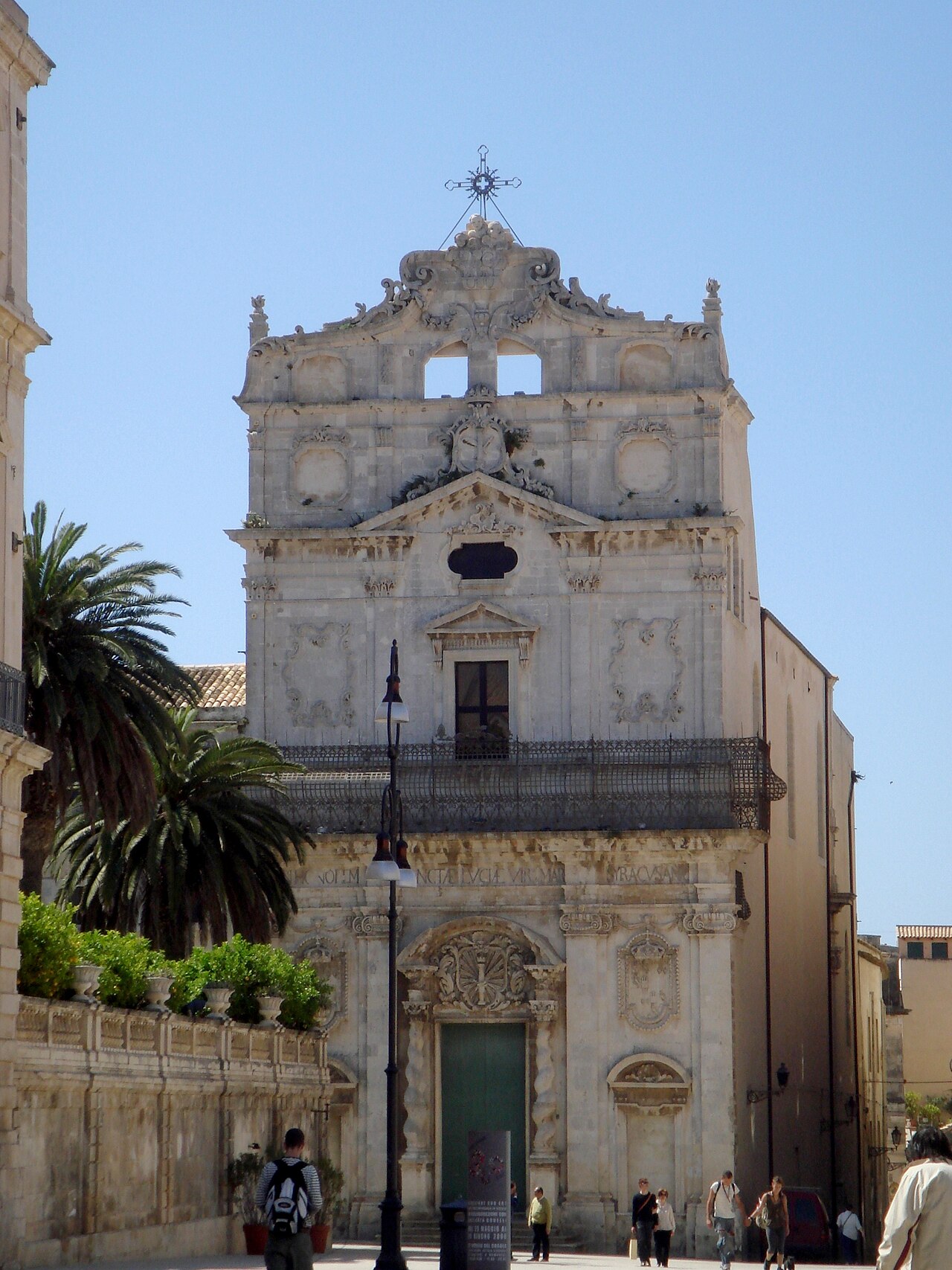
At the southern corner of Piazza Duomo, the Church of Santa Lucia alla Badia is the heart of the worship of the patron saint of Syracuse. Rebuilt after the earthquake of 1693, it features a façade with two orders: the portal is baroque with twisted columns and the saint's coat of arms (the eyes on the cup and the palm of martyrdom), while the crowning is rococo with the wrought iron railing of the nuns' belvedere. THE CARAVAGGIO: Behind the altar is displayed the 'Burial of Saint Lucia', painted by Michelangelo Merisi known as Caravaggio in 1608, during his flight from Malta. The scene depicts the burial of the martyr in the Syracuse quarries: the two gigantic undertakers in the foreground crush the small body of Lucia, while the community's mourning unfolds in an empty and towering space. It is one of the absolute masterpieces of late Caravaggio (a scaled-down conforming copy is preserved in the Nuns' Parlatory). THE SACRED VESTMENTS: According to tradition, they dressed the body of the saint before the transfer of the relics to Constantinople in 1039. Kept for centuries in the silver urn of 1651 and restored in 1992: the dress is a damask silk tunic in purple with floral patterns; the veil, made of very fine silk, has saffron-colored edges and floral decorations on a blue background; the slippers are in purple satin with leather soles. The parchment from 1652 documents the acts of entrustment of the vestments to the Monastery of S. Maria. SAN SEBASTIANO: In the church, the polychrome wooden statue of San Sebastiano, co-patron of the city, is also venerated, transferred here after the destruction of the small church of S. Sebastianello on Via Minerva; the statue shows the arrows and the column of martyrdom. The Brotherhood of the Port Workers and the Municipal Police take care of the feast, on the Sunday following January 20. Santa Lucia is celebrated on December 13 with the grand procession of the silver statue from the Cathedral. The church is stop 1 of the 'Paths of Light', the itinerary of the places of Santa Lucia in Ortigia (including the Cathedral, the Archbishops' Palace, the Carmine, San Filippo Neri, S. Maria dei Miracoli, Palazzo Bellomo, San Martino, and San Francesco all'Immacolata). Free entry; flash photography is prohibited.
With the app, the AI guide accompanies you stop by stop: frame every detail with the camera and let it tell you its story.
The tactile panel at the entrance displays the nine locations of Santa Lucia in Ortigia: 1 Santa Lucia alla Badia (you are here), 2 Cathedral, 3 Archbishops' Palace with the Alagoniana Library, 4 Church of the Carmine, 5 San Filippo Neri, 6 Santa Maria dei Miracoli, 7 Palazzo Bellomo, 8 San Martino, 9 San Francesco all'Immacolata. Outside the walls: the Basilica of Santa Lucia al Sepolcro and the catacombs of San Giovanni.
The masterpiece that Caravaggio painted in Syracuse in 1608, fleeing from Malta: the burial of the martyr in the latomies, with the two colossal gravediggers in the foreground, the small body of Lucia on the ground, and the silent sorrow of the community beneath an immense bare wall. Raking light and scorched earth: all of late Caravaggio in a single scene.
The tunic in the finest purple damask silk with floral patterns that, according to tradition, covered the body of the saint before the transfer of the relics to Constantinople (1039). Kept for centuries in the silver urn of 1651, restored in 1992 along with the veil and the purple satin slippers.
The case contains the saint's finest silk veil — saffron-colored edges and floral decorations on a blue background — along with the large seventeenth-century parchment with the acts of entrustment of the Vestments to the Monastery of S. Maria: the Latin incipit 'Vigesimo sexto aprilis...' can be read.
The canvas of Saint Sebastian on the wooden folding altar: the co-patron saint of Syracuse, pierced by the arrow, venerated here since 1882 after the destruction of the church of S. Sebastianello. In 1929, Archbishop Carabelli placed the golden pectoral cross on the statue in honor of the Brotherhood of the Port Workers. The feast is celebrated on the Sunday after January 20.
In the app, check in on site: you earn a point and the AI guide tells you about the place in your language.