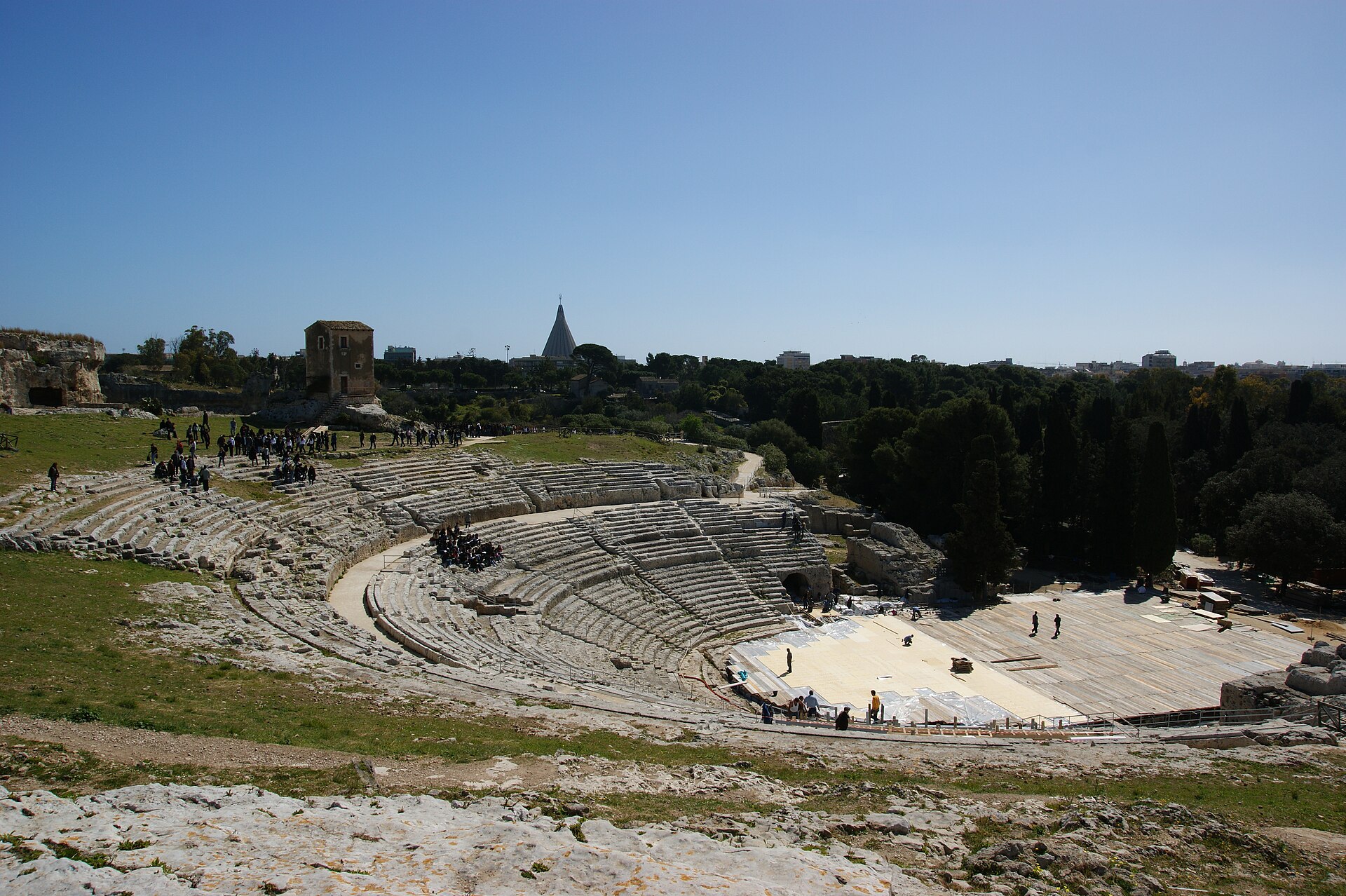
The Archaeological Park of Neapolis is the monumental heart of ancient Syracuse, an area of about 24 hectares on the outskirts of the modern city, a UNESCO World Heritage site. GREEK THEATER (5th century BC): one of the largest and best-preserved in the Greek world, almost entirely carved into the living rock of the Temenite hill; in its current form, attributed to Hiero II (3rd century BC), it had 67 rows of seats for about 15,000 spectators. Here, works by Aeschylus were performed, including 'The Eumenides' composed specifically for Syracuse. Even today, every spring, it hosts the classical performances of INDA — a tradition revived in 1914 with the Agamemnon. LATOMIA DEL PARADISO: an ancient stone quarry up to 45 meters deep, now a lush garden of orange trees and magnolias. Here opens the EAR OF DIONYSIUS, an artificial cave 23 meters high with extraordinary acoustics: the name was given by Caravaggio in 1608, inspired by the legend of the tyrant Dionysius who eavesdropped on prisoners there. Next to it is the Cave of the Ropemakers, used for centuries by rope makers. ALTAR OF HIERON II (3rd century BC): a monumental altar nearly 200 meters long — the largest in ancient Greece — where up to 450 bulls were sacrificed during festivals. ROMAN AMPHITHEATER (1st-2nd century AD): one of the largest in Italy after the Colosseum and the Verona Arena (140x119 m), mostly carved into the rock, intended for gladiatorial games and hunts. Visiting tips: complete route in about 2 hours; in summer, bring water and a hat, there is little shade. From the viewpoint above the theater, the view extends to Ortigia and the sea. PRACTICAL INFO (from the on-site panel): the visiting route of the Roman Amphitheater is a loop around the arena; entrance from the side of Via Paradiso at Largo dell'Amphitheater, near the small church of San Nicolò dei Cordari. Along the route: rest points, drinking water fountains, and restrooms at the entrance. The park is bordered by Via F.S. Cavallari, Viale Paolo Orsi, and Via Paradiso. PARK LOCATIONS (from the panel at the entrance): 1 Greek Theater, 2 Altar of Hieron, 3 Roman Amphitheater, 4 Ear of Dionysius, 5 Cave of the Ropemakers, 6 Latomia del Paradiso, 7 Latomia dell'Intagliatella, 8 Latomia di S. Venera, 9 so-called Tomb of Archimedes, 10 Necropolis Grotticelle, 11 Cave of the Nymph, 12 Via dei Sepolcri, 13 Cave of Salnitro, 14 Centenary Tree. Services: ticket office, bar-ice cream parlor-coffee shop, bookstore, viewpoint, event area. At the entrance, a QR code allows you to download the map of recommended routes based on the time available. In front of the Greek Theater, there is a tactile panel in Braille with the map (Sicily for All project).
With the app, the AI guide accompanies you stop by stop: frame every detail with the camera and let it tell you its story.
The detailed map of the Archaeological Park of Neapolis is an essential tool for navigating the historical wonders of this vast site of 240,000 m². With a satellite view and zoom capabilities, it provides a clear overview of the most famous monuments, such as the Greek Theatre and the Roman Amphitheatre, dating back to the Greek and Roman eras. Additionally, the map indicates points of interest, available services, and allows for easy exploration of the different areas of the park, making the visit an even more engaging and informative experience.
In front of the Greek Theatre, the tactile panel in Braille from the 'Sicily for All' project (created by the Regional Braille Printing House of Catania) displays the layout of the theatre: the large semicircle of the cavea carved into the rock of the Temenite hill, divided into nine fan-shaped sectors by the steps, the semicircular orchestra in the center, and below, the remains of the scenic building. From the position of the panel, one can gaze upon the entire cavea: from here Hiero II watched 15,000 spectators.
The House in the Greek Theatre, located within the Archaeological Park of Neapolis, is a fascinating example of ancient architecture that stands majestically in a context of extraordinary historical and natural beauty. This structure, with its simple façade and tiled roof, offers a picturesque view of the monumental theatre and the surrounding latomies, allowing visitors to immerse themselves in the history of Syracuse. Walking between the Greek Theatre, the Altar of Hiero II, and the Ear of Dionysius, one can sense the cultural and political importance that Syracuse held in the Mediterranean.
The Latomia del Paradiso is a fascinating ancient stone quarry that now presents itself as a lush garden, rich in orange trees and magnolias. This extraordinary site is not only an example of ancient engineering but also hosts the iconic Orecchio di Dionisio, an artificial cave famous for its unique acoustics. According to legend, the tyrant Dionysius used to eavesdrop on prisoners here, making the Latomia a place steeped in captivating and mysterious stories. Located within the Archaeological Park of Neapolis, this area of 240,000 m² is a treasure of Syracusan history, where nature and
The Ear of Dionysius is an extraordinary artificial cave located in the ancient Latomia del Paradiso, right beneath the magnificent Greek Theatre of Syracuse. Standing 23 meters high, this cavity is famous for its exceptional acoustics, allowing even the faintest whispers to be heard. Its name comes from a legend that tells how the tyrant Dionysius used to eavesdrop on the conversations of prisoners. Surrounded by a lush garden of orange trees and magnolias, the Ear of Dionysius represents a fascinating blend of history and nature, making it a must-see stop for anyone visiting the Park
The Grotta dei Cordari, located within the Latomia del Paradiso, is an ancient cavity that once served as a workshop for rope makers, a crucial trade for the daily life of Syracuse. Recently reopened to the public after a long period of closure, this cave offers visitors the opportunity to immerse themselves in a fascinating journey through the artisanal history of the city, surrounded by a lush natural setting of orange trees and magnolias. Next to the Grotta dei Cordari is the Grotta del Salnitro, making the visit an even richer experience.
The Grotta del Salnitro, recently reopened to the public after a long period of closure, is a fascinating example of an ancient quarry used for the extraction of saltpeter. Located in the Archaeological Park of Neapolis, this cave offers a journey back in time, revealing the life and economic activities of ancient Syracuse. Its labyrinthine galleries, enveloped in silence and echo, tell stories of a past rich in history and allure, further enriching the visit to one of the city's most emblematic sites.
The Roman Amphitheater of Syracuse, located in the picturesque Archaeological Park of Neapolis, is one of the most imposing and well-preserved structures of antiquity, capable of hosting up to 15,000 spectators. Carved into the rock, this extraordinary monument was intended for gladiatorial games and public spectacles, offering a fascinating glimpse into the social and cultural life of the time. Set within one of the most significant districts of the ancient city, the amphitheater is alongside other wonders such as the Greek Theatre and the Ear of Dionysius, making the visit a unique experience.
The panel at the entrance of the Roman Amphitheater displays the ring of the visitor route around the elliptical arena (140x119 m). Entrance from the side of Via Paradiso near Largo dell'Anfiteatro and the small church of San Nicolò dei Cordari; along the route there are rest points, fountains, and services. The park is bordered by Via F.S. Cavallari to the north and Viale Paolo Orsi to the east.
In the app, check in on site: you earn a point and the AI guide tells you about the place in your language.